Showing posts with label STPM. Show all posts

Saturday, September 25, 2010

一些以前我收到的stpm trial paper~

刚才在cari 论坛看到一些帖,说现在在考trial。想起我以钱考stpm 时,3年前了~时间真的过得很快~在多一年我就毕业出去社会做工了~真可怜~T.T
当年考完trial,大家都会和别州的学生交换考卷,当年的我也很热诚的参与,哈哈,我把我的电邮放上forum,结果收到了很多别人的考卷~哈哈,其实也没有做完都不知道~


3年过去了,这些trial papers还在我的mail box。
最近很多人search trail paper来到我blog, 我想我应该把当年这些trial paper放出来,让勤劳的你们也能做多些练习,把stpm考好~

一些试卷是压缩zip起来的,你们需要用软件去解压它们。我建议用7zip,可以到这里看看(按我)。另外一些是pdf的,可以用adobe reader或者是foxit reader(按我)。

如果你们想交换考卷,我可以帮你们upload,你们email到cjjack88@yahoo.com给我,或者留下你们的电邮,我forward一些考卷给你们。

----------------------trial papers------------------------
一些之前上载的: http://cjjack88.blogspot.com/search/label/STPM%20trial

---------------------------------------------------------
Sung siew sandakan 2007 trial chemistry p2.pdf
answer -Sung siew sandakan 2007 trial chemistry p2.pdf
----------------------------------------------------------
Year End Examination 2007 (SABS) - with answers.doc
----------------------------------------------------------
SMK dato penggawa barat chemistry p2 2007.rar
---------------------------------------------------------
Sung siew sandakan 2006 trial physics p2.pdf
--------------------------------------------------------
如果你们还想要更多,留言给我,我有时间再upload。
祝大家:考试愉快,^^V
_________________________________________________________________
_________________________________________________________________

Thursday, November 29, 2007

Sijil Tinggi Persekolahan Malaysia

刚才在 Wikipedia 找东西时,看到关于stpm的文章。读了一年半,也该对它要有些了解吧。

Sijil Tinggi Persekolahan Malaysia
From Wikipedia

The Sijil Tinggi Persekolahan Malaysia (STPM, English: Malaysian Higher School Certificate) is a pre-university examination taken by students in Malaysia. It was formerly known as the Higher School Certificate (HSC). The HSC was the precursor to the GCE A levels in the UK, and is still the name of the pre-university examination in some states in Australia.

The STPM is set and run by the Malaysian Examinations Council (Majlis Peperiksaan Malaysia), which also runs the Malaysian University English Test (MUET), unlike Sijil Pelajaran Malaysia (SPM, English: Malaysian Certificate of Education; taken at the end of Form 5), Penilaian Menengah Rendah (PMR, English: Lower Secondary Assessment Test; taken at the end of Form 3) and Ujian Penilaian Sekolah Rendah (UPSR, English: Primary School Assessment Test; taken at the end of Standard/Year 6), which are all set and examined by the Malaysian Examinations Syndicate (Lembaga Peperiksaan Malaysia), both of whom, however, are under the Ministry of Education.

STPM is one of the two major pre-university systems for admission to Malaysian public universities. The other is a one-year matriculation programme conducted by the Ministry of Education. Contrary to popular belief, STPM is not the only qualification accepted besides the matriculation programme and Sijil Tinggi Agama Malaysia (STAM, English: Malaysian Higher Religious Certificate; taken by religious schools' students). Candidates technically may apply for admission to degree-level courses with a variety of pre-university examinations considered equivalent with STPM, including A-Level. All those applying for universities, however, must have taken the MUET.

STPM is internationally recognised by many universities, especially those within the Commonwealth of Nations as well as the United States and the Republic of Ireland. Most universities consider STPM results equivalent to GCE A-Level results.

Form Six

STPM candidates sit for no more than five subjects, all within the same examination season. All Science- and Mathematics-related subjects (Mathematics S, Mathematics T, Further Mathematics T, Computing, Physics, Chemistry, and Biology) are offered bilingually in English and Malay until 2007, when they will be offered only in English. All other exams, other than languages, are still offered only in Malay and are likely continue to do so for the foreseeable future.

STPM is an open-list examinations; that means any combination of subjects may be taken. However, to be considered for Malaysian public university admission, students must take Pengajian Am (General Studies) and at least three other subjects. Most, if not all, schools and colleges offering STPM, however, do stream their students into science and arts (humanities).

A list of all subjects available for STPM students are:

*Pengajian Am (General Studies)
*Bahasa Melayu (Malay language)
*Bahasa Cina (Chinese language)
*Bahasa Tamil (Tamil language)
*Bahasa Arab (Arabic language)
*Literature in English
*Kesusasteraan Melayu (Literature in Malay)
*Pendidikan Islam (Islamic Studies)
*Syariah (Syariah)
*Usuluddin (Islamic studies)
*Sejarah (History)
*Geografi (Geography)
*Ekonomi (Economics)
*Pengajian Perniagaan (Business studies)
*Perakaunan (Accountancy)
*Mathematics S (may not be taken with Mathematics T)
*Mathematics T (may not be taken with Mathematics S)
*Further Mathematics T (may only be taken with Mathematics T)
*Computing (may only be taken at certain schools)
*Physics
*Chemistry
*Biology
*Sains Sukan (Sport science)
*Seni Visual (Visual Art)
*For most non-science and sport science subjects, there are generally two papers per subject. For science subjects, there are three papers, with the third a practical paper[1] (though all but Computing offers a written paper as an alternative for private candidates).

Mathematics S and Mathematics T[2] share the first paper (consisting of Pure Mathematics), while with slightly different second papers, the prior with a more business mathematics approach while the latter a more science-related and statistical approach. Both subjects have both their papers graded separately on a different curve, though all questions shared between the subjects are marked with the same, secret marking scheme.

Grades and Grade Points

STPM uses a Cumulative Grade Point Average (CGPA) system. There are 11 grades, which are A, A-, B+, B, B-, C+, C, C-, D+ and D, with F as the failing grade. The grade points for each of these grades are between 4.0 and 1.0, A being 4.0 and D- being 1.0. The F grade gives a grade point of 0.

Grade and Grade points

A - 4.00
A- - 3.67
B+ - 3.33
B - 3.00
B- - 2.67
C+ - 2.33
C - 2.00
C- - 1.67
D+ - 1.33
D - 1.00
F - 0.00
In order to pass a paper, candidate must at least score a C(2.00) or above. Having a grade between D to C- is a principal pass (lulus separa).

Each paper's grade appears on the result slip and the certificate. The subject's grade and grade point is determined by the weighted average results of all papers in that subject, where all papers must be passed, otherwise the grade and grade point would be, respectively, F and 0. The cumulative grade point average is the average of the top four subjects taken and usually rounded up to 2 decimal points. Therefore, if a student scores A in four subjects and fail in the fifth, his CGPA would be 4.0.

The actual range of scores within each grade is undisclosed and changes annually, depending on the performance of the candidates. Usually, the range of marks of science subjects is relatively higher than non-science subjects.

Cumulative and subject GPA at 2.0 and above is considered a pass with credit or principal pass. GPA below 2.0 is considered a sub-fail, and a 0 is considered a fail. Admissions to local public universities requires at least a GPA of 2.0 and above, though private universities, university colleges and colleges generally may accept student with CGPA less than 2.0.

The CGPA system in STPM poses some problems for admissions to American universities because the GPA range between 4.0 and 0 (unlike Advance Placement range of 5.0 to 0) may understate the academic achievements of an applicant

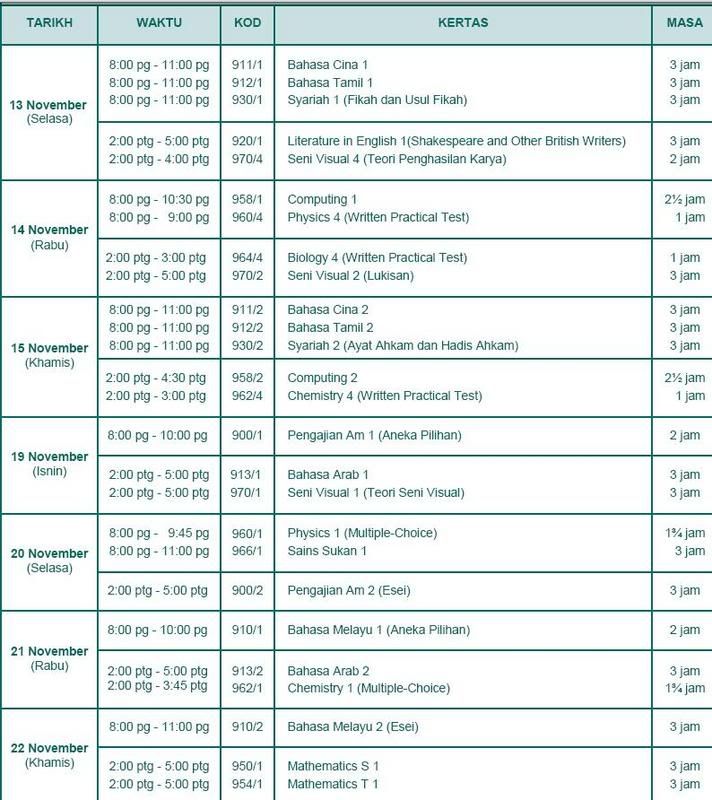
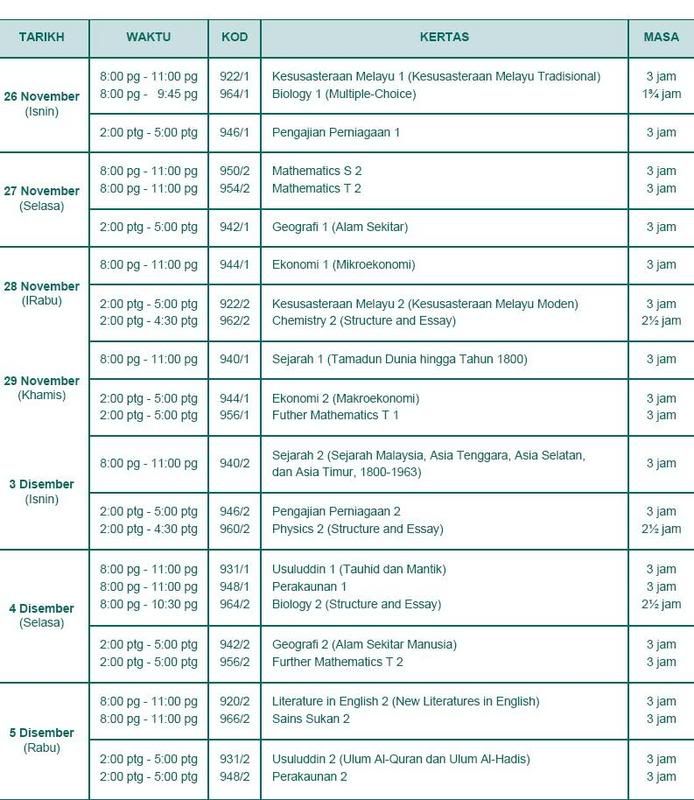

Saturday, September 22, 2007

STPM Mathematics T, Mathematics S and Further Mathematics Syllabuses
Please take note that the first eight topics (Paper 1) of Maths T and Maths S are the same. Besides, Maths T and Maths S are mutually exclusive. In other words, a STPM candidate cannot take both subjects at the same time. Maths T is taken by most science stream stuedents whereas Maths S is taken by some art stream students. Meanwhile, Further Maths is taken as the optional fifth subject by some science stream students.
STPM Mathematics T (also known as Pure Mathematics) Syllabus
1.Numbers and Sets
Real numbers
Exponents and logarithms
Complex numbers
Sets
2.Polynomials
Polynomials
Equations and inequalities
Partial fractions

3.Sequences and Series
SequencesSeries
Binomial expansions
4.Matrices
Matrices
Inverse matrices
System of linear equations
5.Coordinate Geometry
Cartesian coordinates in a plane
Straight lines
Curves

6.Functions
Functions and graphs
Composite functions
Inverse functions
Limit and continuity of a function
7.Differentiation
Derivative of a function
Rules for differentiation
Derivative of a function defined implicitly or parametrically
Applications of differentiation
8.Integration
Integral of a function
Integration techniques
Definite integrals
Applications of integration
9.Differential Equations
Differential equations
First order differential equations with separable variables
First order homogeneous differential equations
10.Trigonometry
Solution of a triangle
Trigonometric formulae
Trigonometric equations and inequalities
11.Deductive Geometry
Axioms
Polygons
Circles

12.Vectors
Vectors
Applications of vectors
13.Data Description
Representation of data
Measures of location
Measures of dispersion
14.Probability
Techniques of counting
Events and probabilities
Mutually exclusive events
Independent and conditional events
15.Discrete Probability Distributions
Discrete random variables
Mathematical expectation
The binomial distribution
The Poisson distribution

16.Continuous Probability Distributions
Continuous random variable
Probability density function
Mathematical expectation
The normal distribution
STPM Mathematics S (also known as Statistical Mathematics) Syllabus
1.Numbers and Sets
Real numbers
Exponents and logarithms
Complex numbers
Sets
2.Polynomials
Polynomials
Equations and inequalities
Partial fractions

3.Sequences and Series
SequencesSeries
Binomial expansions
4.Matrices
Matrices
Inverse matrices
System of linear equations
5.Coordinate Geometry
Cartesian coordinates in a plane
Straight lines
Curves

6.Functions
Functions and graphs
Composite functions
Inverse functions
Limit and continuity of a function
7.Differentiation
Derivative of a function
Rules for differentiation
Derivative of a function defined implicitly or parametrically
Applications of differentiation

8.Integration
Integral of a function
Integration techniques
Definite integrals
Applications of integration

9.Linear Programming

10.Network Planning

11.Data Description

12.Probability

13.Probability Distributions

14.Sampling and Estimation

15.Correlation and Regression

16.Time Series and Index Number

Friday, September 21, 2007

964 BIOLOGY
Aims
This syllabus aims to enhance students’ knowledge and understanding of biology to enable them to further their studies at institutions of higher learning or to assist them to embark on related careers, and also to promote an awareness among them of the role of biology in the universe.

Content
1.The biology of molecules and cells
2.Energetics
3.Gaseous exchange, transport, and homeostasis
4.Control and coordination
5.Reproduction, development, and growth
6.Genetics
7.Taxonomy, biodiversity, and theory of evolution
8.Ecology

Form of Examination
Candidates are required to enter for Papers 1, 2, and either Paper 3 or Paper 4.
Paper 1 (1¾ hours): 50 compulsory multiple-choice questions are to be answered.
Paper 2 (2½ hours): 4 compulsory structured questions in Section A and 4 out of 6 essay questions in Section B are to be answered.
Paper 3 (School term): 13 compulsory experiments are to be carried out for school-based assessment of practical work.
Paper 4 (1 hour): 2 compulsory structured questions are to be answered in this written practical test which is an alternative to Paper 3. Candidates repeating upper six, candidates taking an additional science subject outside the school time-table, and private candidates are required to take this paper.
962 CHEMISTRY
Aims
This syllabus aims to enhance students’ knowledge and understanding of chemistry to enable them to further their studies at institutions of higher learning or to assist them to embark on related careers, and also to promote an awareness among them of the role of chemistry in the universe.

Content
1.Matter
2.Electronic structure of atoms
3.The periodic table
4.Chemical bonding
5.Reaction kinetics
6.Equilibria
7.Electrochemistry
8.Thermochemistry and chemical energetics
9.Period 3 and Group 2: Selected properties
10.Group 13: Aluminium
11.Group 14: C, Si, Ge, Sn, Pb
12.Group 15: Nitrogen and its compounds
13.Group 17: C1, Br, I
14.An introduction to the chemistry of d-block elements
15.The chemistry of carbon
16.Hydrocarbons
17.Haloalkanes
18.Hydroxy compounds
19.Carbonyl compounds
20.Carboxylic acids
21.Carboxylic acid derivatives
22.Amines
23.Amino acids and proteins
24.Polymers

Form of Examination
Candidates are required to enter for Papers 1, 2, and either Paper 3 or Paper 4.
Paper 1 (1¾ hours): 50 compulsory multiple-choice questions are to be answered.
Paper 2 (2½ hours): 4 compulsory structured questions in Section A and 4 out of 6 essay questions in Section B are to be answered.
Paper 3 (School term): 15 compulsory experiments are to be carried out for school-based assessment of practical work.
Paper 4 (1 hour): 3 compulsory structured questions are to be answered in this written practical test which is an alternative to Paper 3. Candidates repeating upper six, candidates taking an additional science subject outside the school time-table, and private candidates are required to take this paper.
960 PHYSICS

Aims
This syllabus aims to enhance students’ knowledge and understanding of physics to enable them to further their studies at institutions of higher learning or to assist them to embark on related careers, and also to promote an awareness among them of the role of physics in the universe.

Content
1.Mechanics
2.Waves
3.Properties of Matter
4.Thermodynamics
5.Electricity and Magnetism
6.Optics
7.Quantum Physics
8.Atomic Physics
9.Nuclear Physics

Form of Examination
Candidates are required to enter for Papers 1, 2, and either Paper 3 or Paper 4.
Paper 1 (1¾ hours): 50 compulsory multiple-choice questions are to be answered.
Paper 2 (2½ hours): 7 to 8 compulsory structured questions in Section A and 4 out of 6 essay questions in Section B are to be answered.
Paper 3 (School term): 15 compulsory experiments are to be carried out for school-based assessment of practical work.
Paper 4 (1 hour): 2 compulsory structured questions are to be answered in this written practical test which is an alternative to Paper 3. Candidates repeating upper six, candidates taking an additional science subject outside the school time-table, and private candidates are required to take this paper.

LinkWithin

Related Posts with Thumbnails